Trip report: Iberia domestic business class Barcelona Madrid Lisbon

by Vishal Mehra

Last week, I reviewed Iberia’s domestic Business Lounge in Barcelona.

Today, I focus on my first flight with Iberia from Barcelona to Lisbon, via Madrid. This was also my first flight in business class.

Barcelona El Prat - Madrid Barajas
Flight IB2713. Airbus A320. Seat 5F. Business Class
Departure - 18:50, on-time

For intra-Europe and many north African flight, most European airlines don't have a separate cabin for business class passengers. Instead, they use a mobile curtain that is moved after each flight in order to separate both according to the number of passengers flying business class in each flight. This allows airlines to be more flexible, since an Economy class seat can be converted into a business class seat just by moving the curtain.

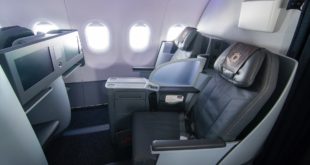
My Iberia business class seat was essentially an upgraded economy seat with increased seat pitch (34 inches, instead of 31 in economy) and an empty middle seat for increased comfort.

As I settled into my seat I was offered water and something to munch on, while the cabin was getting ready for departure to Madrid. Our departure was smooth, and looking down at Barcelona I saw the beauty of the city once more albeit with an aerial view, bathed in sunshine.

Soon after reaching cruising height, a purser came over and asked for my choice of drink. As this was a short one hour flight, and it was early evening, there was no specific meal service. I must have waited for fifteen minutes for my apple juice to arrive before drifting off for a short nap.

I woke up while we were on our landing approach to Madrid Barajas and I never got my drink, and considering we were on approach, I did not bother reminding the crew of their slip-up. Humans tend to forget things and considering it was my first ever outing in semi business class, I was in good enough humour to forgive as well, but Iberia should take note of such slip-ups, which while minor, have large impact on passenger impression when they occur in the premium cabin.

Looking through the magazine I chanced upon Iberia giving out Pizza at 36000 feet to its passengers, which I thought was pretty unique.

We landed in Madrid on time, disembarkation was quick and I went to explore the airport's famous wavy-roof terminal and the flagship Iberia lounge.

Madrid Barajas – Lisbon Portela International
Flight IB3118. Airbus A320. Seat 1A. Business Class
Departure 2245, on-time
Seat 1A

I was excited about sitting in seat 1A, that magical number in airline seating wanted by enthusiasts, which was automatically allotted to me by Iberia. Business class was the same upgraded economy class with increased leg room, but this time there was just two rows of business class seats, and two out of the eight available seats remained unoccupied, including the aisle seat in my row i.e. 1C, giving me a full three-seater to myself.


Flipping through Iberia’s magazine, I came across this print ad featuring the Taj Mahal and promoting Incredible India. Bought a big smile to my face.


The pre-departure service consisted of a drink and nuts. I chose to go for a tried and tested cerveza, or beer (in English). Service on this flight was better, may be because it was a Schengen flight and I was surprised to find a full-blown dinner served during this short one hour hop to Lisbon. The fish and salad did not appeal to my taste buds, and I moved quickly to dessert.


As soon as I finished dinner we were descending to Lisbon and the beautiful city came in the view with bright lights and hills around it. The landing again was a smooth affair and within five minutes we were at the disembarkation point.

The only negative aspect of this flight was the exit through stairs and buses ferrying passengers to the main terminal. May be it was a short-coming of the airport, considering it was past 11pm at night, but then a full service airline like Iberia should work closely with airport authorities to ensure no dilution in their service offerings.

- Vishal Mehra is a digital marketer at a global agency, smitten by travelling and commercial aviation. He tweets a lot and off late has taken to blogging as well. Follow him on Twitter and visit his blog.
Read more »

Air France and KLM partner with Jet Airways to expand India connectivity

Air France and KLM Royal Dutch Airlines, have entered in to a unilateral code-share agreement with India's Jet Airways which will allow them to extend their connectivity to Indian cities which are currently not served by them.

At present Air France and KLM operate 27 flights a week to India. Air France has flights from Paris Charles De Gaulle (CDG) to Bangalore, Mumbai and New Delhi, while KLM operates from Amsterdam Schipol to New Delhi. From June 19, 2013, Air France will place its marketing code (AF) on Jet Airways’ domestic flights to Chennai from Bangalore, New Delhi or Mumbai and Kolkata and Hyderabad via Bangalore and Mumbai. Likewise, KLM will place its marketing code (KL) on Jet Airways’ domestic flights to Bangalore, Chennai, Hyderabad and Mumbai via New Delhi.

The three airlines already have a full fledged network-wide accrual and redemption partnership for their frequent flyer programs, Jet Airways’ JetPrivilege and Air France-KLM’s Flying Blue, for many years.

The announcement did not indicate if there will be a reciprocal code-share arrangement where Jet Airways would put its flight numbers on Air France and KLM operated flights between India and Europe. A spokesperson for Air France indicated the agreement was unilateral. Jet Airways did not respond.

Read more »

What are "Hot and High" operations? Why airlines prefer four engined jets.

by Vinay Bhaskara

Image Credit - International Airlines Group (IAG)
One of the most interesting challenges in aviation arises from operations in severe conditions, extreme cold, short runways, and more commonly, operations from so-called “hot and high” airports; airfields with high temperatures that are situated at a high altitude.

This curious phenomenon is actually the impetus behind several seemingly incongruous strategic decisions by airlines. It is the reason that Iberia has not yet abandoned its gas-guzzling fleet of Airbus A340s, and the reason that Aeromexico’s Asian flights originate in Mexico City but make a technical stop along the way in Tijuana.

The problem occurs primarily due to constraints on take-offs and landings, which harken back to the basic physics of aerodynamics. Aircraft generate lift by using power from the engine to flow air over the wings. More specifically on takeoff, the engine burns fuel to heat up the air and flow a large mass of air through the engines; generating thrust, which allows the aircraft to speed up down the runway and climb away from the airfield.

However, hot and high operating conditions change this simple calculus in several ways. Firstly, if the airport is located in a region of high altitude, the air pressure is lower and the air is less dense. This means that, at any given speed (all else being equal), a smaller mass of air is flowing through the engines; so a higher airspeed is required to develop enough thrust to take off with a given payload versus at a sea-level airport. The easiest way for an aircraft to make up for this deficit is to roll further down the runway before taking off; thus high-altitude airports tend to have some of the longest runways in the world (e.g. Denver International Airport, with an altitude of more than 1,655 meters, has a 16,000 foot runway designed to handle larger aircraft with high payloads). Even after taking off, aircraft will struggle to climb away from the airfield due to the lower density of the air (again relating to a dearth of thrust).

A similar problem plagues airports with high temperatures. Once again heating air decreases its density, which causes the same mass of air limitations driven by high altitudes. However, high temperatures present an additional challenge in that jet engines have a maximum temperature that they can heat gas up until (The exhaust gas temperature or EGT). On hotter days, there is less difference between the air temperature and the EGTs, meaning the engine adds less heat through the air than in cooler conditions, once again affecting thrust. Thus, airports in high temperature regions also tend to require longer runways (examples include airports in the Southwestern United States, the middle east, North Africa, and the Indian sub-continent). The current standard estimates that the adverse effects of high temperatures kick in en-mass when temperatures rise above 30 degrees Celsius.

It is when these two conditions are combined, that a particularly dangerous cocktail arises; the hot and high airport. When temperatures are high at high altitudes, engine thrust performance deteriorates heavily because the air density is even lower. It is little wonder that such conditions are amongst the most challenging in the world for airlines to operate to and from, even more so when their central hub is located at such an airport. Perhaps the most famous hot and high airports in the world are Mexico City and Johannesburg, home to Aeromexico and South African Airways respectively, as well as several airports in Africa and South America (the core markets for Iberia’s long haul operations).

Bangalore, the home to this site, is another challenging airport for hot and high operations. Located at an altitude of 3,000 ft and thanks to indiscriminate development which has denuded the green cover, the former temperate paradise, frequently tops 35 degrees Celsius or 95 degrees Fahrenheit. It is not uncommon to see smaller Code-C aircraft (Boeing 737s and Airbus A320s) have take-off runs exceeding 3,000 meters (approx. 10,000 ft) during the peak hot hours from around noon to 4pm.

This explains why Iberia and South African Airways have held onto their fleets of 4-engined Airbus A340 aircraft longer than other airlines; quad-jets perform better in hot and high conditions. The reason is mainly due to a worst case scenario; loss of power in one engine.

It really comes down to the fact that if a quad-jet loses one engine, it still has 75% of its maximum thrust, while twin-jets like the Boeing 777s and A330s in the same situation will have only 50% of their engine power available in a failure scenario. Thus the quad-jets can carry more payload given runway length constraints at many of these airports (this used to be a major problem at Mariscal Sucre Airport in Quito).
Read more »

Video highlights of Airbus A350 AWB maiden flight vs. Boeing 787 first flight

In case you missed the first flight of Airbus' newest aircraft the A350 XWB on June 14th, below are the video highlights.


Compare with the first flight video highlights of the Boeing 787 3.5 years earlier, on December 15, 2009. Both flights picture perfect. The US airframer was gallant in congratulating its main competitor for its achievement.


Have a great week ahead.

Videos courtesy Airbus S.A.S. and Boeing
Read more »

She Flies!!!!! Airbus A350 XWB first flight in pictures

Congratulations to the Airbus team. The A350XWB has taken-off on its maiden flight from Toulouse Blagnac airport in France. Till the official pictures come, a few screen shots from the streaming video from Airbus.

Awaiting behind the delivery flight of the Cebu Pacific A330

The Airbus wide-body flight line. Dominated by A330s and an A380. Compare the larger A350 with the smaller A330.

Getting ready to taxi to holding point on the runway. The chase plane, a SN-600 Corvette is on the adjacent exit.

The A350 with the Airbus flight line behind.

The chase plane readies for take-off.

At runway holding point.

All lined up.

Start the take-off roll

Lift-off!!!!!!


In the air. The flaps and landing gear are kept lowered till the basic flight manoeuvres are completed and the crew finds the aircraft configuration "clean".

In the air

Approaching runway 32L to land

Touchdown!!!!

Exiting the runway

Flight test engineer Pascal Verneau waves an Airbus flag to celebrate the completion of a successful first flight. 

Video feed courtesy Airbus
Read more »

Watch the Airbus A350 XWB first flight live

The Airbus A350 XWB is performing its first flight today, June 14, 2013. You can watch the video feed live.

Read more »